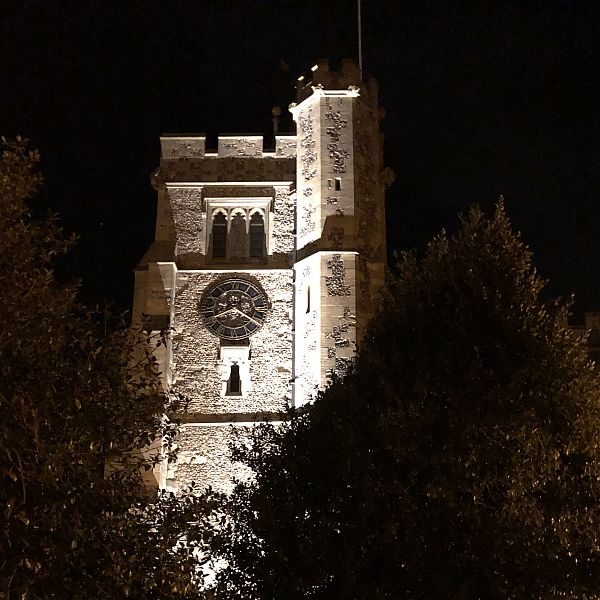
In downlighting, the light source is placed above the object to be lit. Downlighting is usually used to emphasise the architectural features of a house or garden buildings, to highlight doorways or gates, or to spotlight objects such as planters or benches. The eerie effect here was created by downlighting a gargoyle.
Like all lighting, garden lighting creates shadows which can be used to great dramatic effect. Shadows of leaves, topiary, trellising or statuary can be projected onto house walls, or across lawns, decks or terraces. Adjusting the size of these shadows can be a very effective way to evoke strong moods on the night-time garden.
Whether lighting a simple step on a garden path, or an entire staircase - as in this Guildford garden - minimising glare is a safety issue. It's also an aesthetic consideration. Unless the steps are a distinctive architectural feature in their own right, the use of discreet fittings that create little light spill will avoid distracting attention from more interesting features in the lit garden.
Cross lighting is similar to uplighting, in that the light source is placed below and in front and in front of the object to be lit. Where it differs is that instead of placing one light source directly in front of the object, two light sources, some distance apart, are placed in front of the object. This double beam of light from two different angles makes the object appear more three-dimensional and solid. Here we have shown a variation of cross lighting where the two light sources are placed behind the bench to create an interestingly architectural shadow.
Many lighting effects rely on focusing a tightly defined beam of light at a single point of interest. Moonlighting does the opposite. It’s created by shining, from above, a wide beam of light across a relatively large area. The fitting is usually mounted on a high branch of a tree. The result is a soft, diffused light – perfect for creating a soothing atmosphere for a seating area. In the Hampshire garden we have used it to cast shadows of leaves across the seating area in a summer house.
Most garden lighting illuminates static features. Lighting the flow of a fountain or other water feature introduces movement into the night-time garden. To uplight the flow, waterproof fittings can be safely immersed in the water. Alternatively, fittings can be concealed in nearby planting or incorporated unobtrusively in the hardscaping.
Sometimes also called backlighting, silhouetting is when the light source is placed behind the object to be lit. It can be used to create truly dramatic lighting effects. An opaque object, such as a statue, will have its outline defined, but its detail will remain shrouded in shadow. A translucent object, however – like the foliage in the picture – will shine.
At night, a pool, pond or lake is a mirror. Lighting an object near the edge of the water, or branches overhanging it, will create a reflection in its surface. On a still night, it will be a perfect mirror image. When a soft breeze blows, the reflection will dance on the ripples.
Uplighting is when the light source is placed in front of, and below, the object to be lit. It's especially effective for highlighting a large focal point in the garden - a tree, a big shrub, or architechtural features such as pillars, statuary and urns. Here, we uplit three sliver birches in the New Forest.
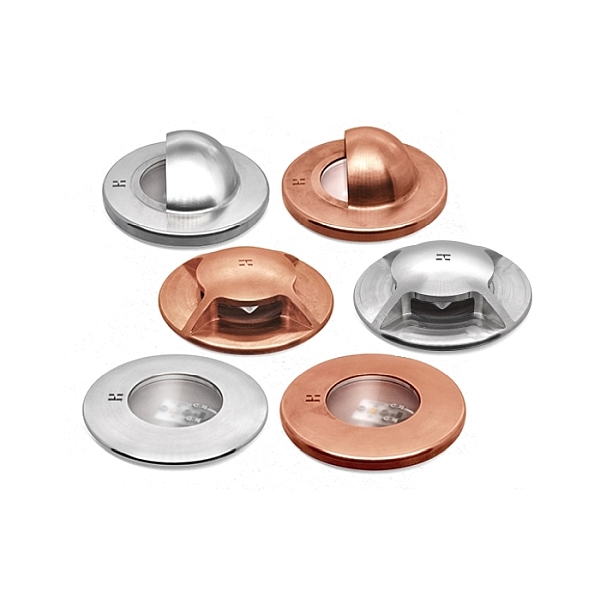
Spread lighting uses specially designed fittings mounted on a short stand to throw pools of light onto the ground. Ideal for illuminating low level planting, it is also an effective alternative for lighting paths or driveways. These copper fittings cast a warm, reddish light and blend well with their surrounds as they weather.
Wash lighting, as its name suggests, is used to 'wash' a surface with light. The solid surface might be the ground, a wall, even a fence. The light source is placed as close to the surface as possible so the play of light and shadow across it emphasises its texture.
Path lighting needs no explanation, but it does need careful planning. The light beam needs to be kept at ground level because if path lights dazzle, the effect will be uncomfortable and, possibly, hazardous. If a path is to be lit as part of a wider garden lighting scheme, keeping the path lighting discreet will usually enhance the impact of the lighting elsewhere. Dramatic effects can also be achieved using path lighting to mark any boundary. Here we used it to illuminate the boundary of a blue-painted deck.
Welcome to Light Ideas International Ltd / Hunza Europe
Light Ideas International Ltd / Hunza Europe, are UK and Europe’s sole importer of Hunza exterior lighting products
The Hunza outdoor lighting range features over 100 discreetly styled low voltage and mains luminaires, which have been specifically designed for every conceivable exterior and architectural lighting requirement. Our product range is continually evolving as we listen, and react to customer feedback and special requirements.
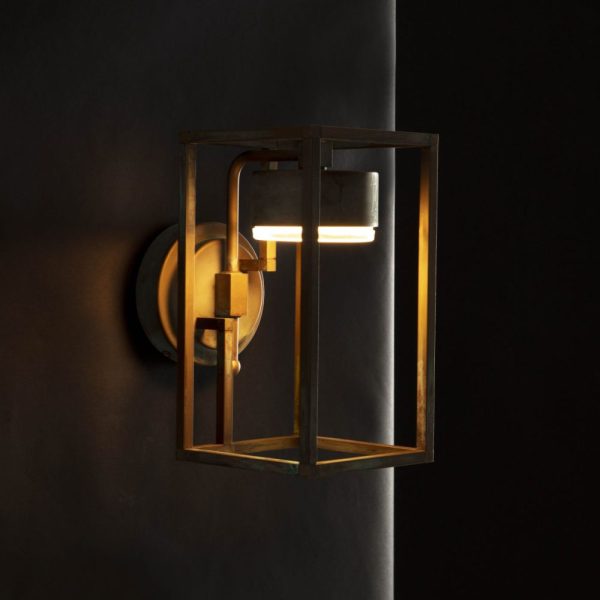
We have exterior lighting products for path lighting, step lighting, deck lighting, driveway lighting, pool lighting, pond lighting and marine lighting. There are also spotlights for up lighting, and outdoor wall lights for down lighting. Our complete range of luminaires also has the flexibility of an option of LED light source.
Hunza exterior lighting is precision engineered and carefully assembled by hand in New Zealand rather than being mass-produced. Products come with impressive guarantees – 5 years for powder-coated fittings and 10 years for luminaires in copper or 316 stainless steel.
Light Ideas International Ltd / Hunza Europe are based in the Midlands, UK. We are dedicated to bringing you only the very best in home and garden lighting, with a service that is as reliable and efficient as the products we sell.
We hold a substantial amount of stock so that we can usually provide very rapid delivery – typically next day in the UK and 3-4 days to Europe. Any non-stock items have a typical lead time of around 3-4 weeks.
Hunza luminaires in the UK & Europe
We also have an established network of local suppliers across the UK and Europe.
To find out the Hunza distributor nearest to you, please contact us with your details and location. Your nearest supplier will then contact you within 24 hours.
For any enquiries please call us on 01384 377378, or send us an Email via our contact page, we will be delighted to hear from you.